

Arches National Park
Arch Canyon
Canyonlands National Park
Canyons of the Ancients NM
Cedar Mesa
Comb Ridge
Dark Canyon
Edge of the Cedars
Four Corners Monument
Glen Canyon Rec Area
Goosenecks State Park
Grand Gulch
Hovenweep NM
Manti-Lasal Forest
Moki Dugway
Monument Valley
Muley Point
Natural Bridges NM
Newspaper Rock SP
Rainbow Bridge NM
San Juan River
Valley of the Gods
White Canyon
Hovenweep National Monument





Lorem ipsum dolor sit amet.
Lorem ipsum dolor sit amet.2
Lorem ipsum dolor sit amet.3
Lorem ipsum dolor sit amet.4
Lorem ipsum dolor sit amet.5
Lorem ipsum dolor sit amet.6
<
>
6 - 6
ANCESTRAL PUEBLOAN RUINS
Hovenweep means, "deserted valley", owed to the fact that the ancestors of today's Pueblo Native American people abandoned the area about the turn of the 14th century A.D.
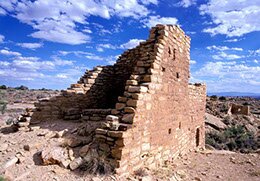
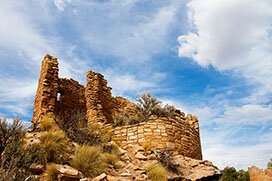
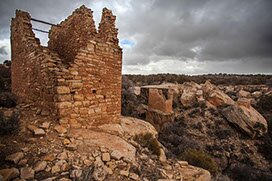
Ancient ruins discovered and preserved within a part of a Ute Indian Reservation near the Four Corners Monument make up Hovenweep National Monument. There are six groups of ruins within the Monument, left behind by the ancient ancestral Puebloan people during the end of their occupation of the Four Corners Area. The several structures, left behind in about 1200-1300 A.D., are some of the most advanced architecture ever constructed by the Anasazi.
A 45 minute drive from Blanding, UT is all that separates guests from this remarkable monument. When driving to Hovenweep, guests are strongly encouraged to use a map, rather than relying on GPS, because of the several unpaved backroads which sometimes lead visitor's astray.
Square Tower Group
The largest collection of Anasazi, or ancestral Puebloan, structures in the park are found here in this group. In and around Little Ruin Canyon, the remains of almost thirty independent structures, or ruins, have been found. Most of these are thought to have been kivas, used for ceremonial purposes. The area is estimated to have been the dwelling place of around 500 people.
Square Tower itself, the structure for which the group is named, is a three-story tower build on a boulder at the mouth of Little Ruin Canyon.
The square tower group is located near the visitor's center and is the only group that can be reached by a paved road. A moderately difficult trail circles around the several ruins, about 2 miles long. Many of the ruins nearest the visitor's center can be reached by person's in a wheelchair.
The Square Tower group consists includes Square Tower, Hovenweep Castle, Stronghold House, Hovenweep House, Twin Towers, Boulder House, and several others.
Cutthroat Unit
The cutthroat group is found farther down the canyon in which it resides, rather than at the mouth, as are the other units. The cutthroat castle, unlike most kivas, is not built partially underground, but rather, rests on top of a boulder.
Though it may seem small now, the population at the cutthroat group was actually quite large. Because of the area's geology, there were several springs which created an ideal living environment here.
Holly Unit
Named after Jim Holley, a local rancher and trader in the 1800s. The structures in the Holley Site include Holly House, Tilted Tower, and Holly Tower. All of these are located at the head of Keeley Canyon.
The tall Tilted Tower was built on a builder, which shifted some time after the site was abandoned in the 1300s. When the boulder shifted, the top stories of the ruin collapsed into the canyon, leaving only the base level intact.
Cajon Unit
Several small remains under a canyon ledge, and a few standing structures give evidence that around 100 people lived at the Cajon Site. The most notable structure is a circular tower, built amid three boulders on completely uneve ground, a tribute to the skill of the ancestral Puebloan architects.
Horeshoe Unit
Horseshoe tower is built upon the point of the rim of Horseshoe Canyon. Further along lies Horseshoe House, whose structures are arranged in the shape of a horseshoe, giving the ruins and the canyon their names.
Hackberry Unit
About a quarter mile east of the Horseshoe Site sits the Hackberry unit. This site has the most abundant supply of water of all the sites at Hovenweep.
About Hovenweep
